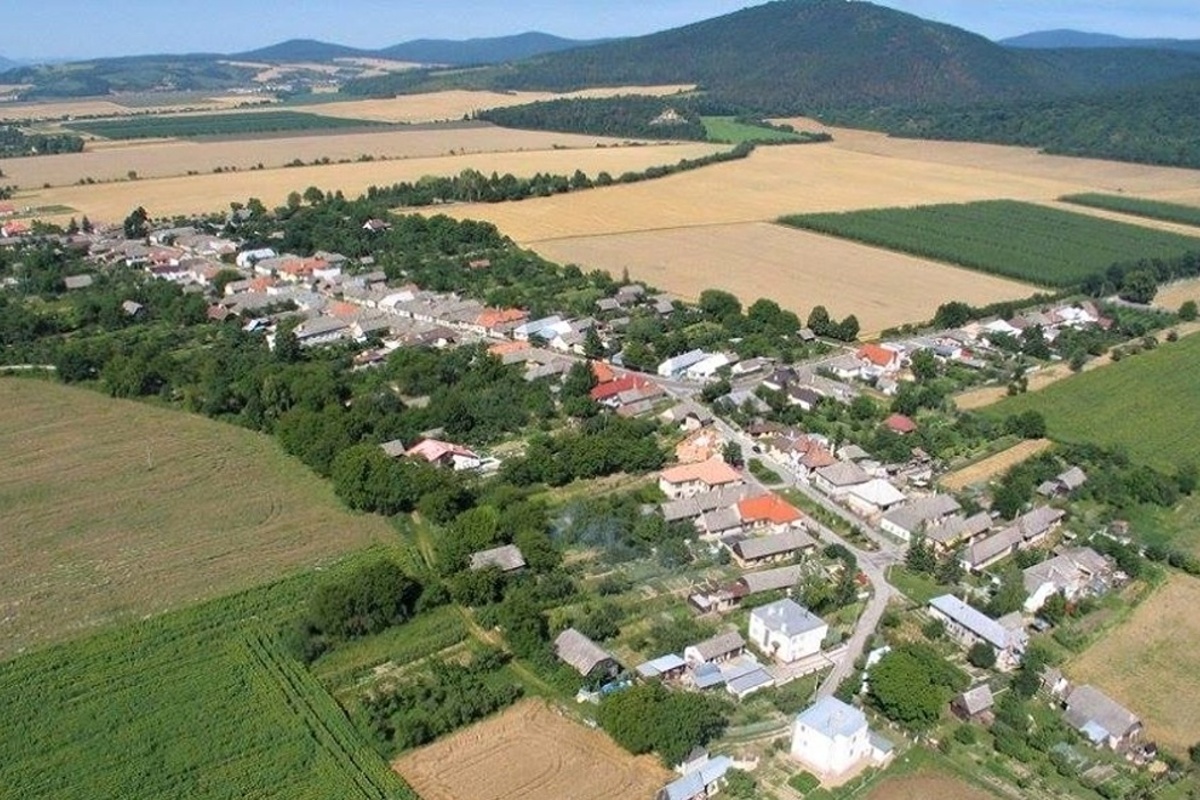


Exploring the architectural heritage and cultural history of our ancestral village.
Every village has its heart, shaped by centuries of faith, hard work, and community life. Nová Ves nad Váhom is no exception. Its landscape is dotted with historical monuments that tell the stories of our ancestors—those who lived here for generations, as well as those who departed from these very places for America in 1906. Let’s take a journey through the historical landmarks and defining milestones of our home.
The Spiritual Heart: The Church of St. Martin the Bishop
The most prominent landmark of the village is the Roman Catholic Church of St. Martin the Bishop. Its history dates back to the end of the 13th century, originally built as a single-nave Early Gothic church with a Renaissance tower.
Over the centuries, the church underwent several transformations:
- 1538 & 18th Century: Major reconstructions and expansions.
- 1921: The interior of the old church was beautifully painted by the artist M. Veselý.
- 1943: To accommodate the growing community, builder F. Szokolóczi constructed a large new church section attached to the northern wall of the original nave, based on a design by architect Š. Paulík. This new part was dedicated to the Divine Heart of Jesus.
- 1972: The church was enriched with a modern pneumatic organ with an electric pump, crafted by the renowned Rieger-Kloss company from Krnov.
Parsonage, Chapel, and Lost Heritage
The spiritual administration of the village was centered around the Roman Catholic parsonage. Originally built in 1791 as a wooden structure with a shingle roof, it unfortunately burned down in 1821. In 1829, a new, sturdy parsonage was erected using stone and brick. Right next to it, a chapel was built in 1843, which was later reroofed and modified. Nearby, a stone statue of the Virgin Mary from the 19th century still stands today.
The village was also historically home to a Jewish community. A synagogue (Jewish church) was built here in 1796, serving its purpose for over a century and a half until it was sadly demolished in 1953. Another place of spiritual reflection is the Grotto of Our Lady of Lourdes located within the village.
Footprints in the Landscape: Stone Crosses and the Novanska Valley
In the 19th century, faith was also carved into stone roadside crosses, which have withstood the test of time and still stand today. One can be found just outside the village on the way to the sports field, and the second stands opposite the local agricultural cooperative (PD) buildings.
If we venture into the Novanska Valley (Novanská dolina), we find traces of early rural industry and forestry. At the beginning of the 19th century, a traditional gamekeeper’s lodge (hájovňa) and a functional water mill were established here, utilizing the natural resources of the surrounding nature.
Historical Timeline: From Education to Modernization
Beyond its monuments, the modern history of Nová Ves nad Váhom was shaped by rapid development in education, culture, and infrastructure during the 20th century:
- 1905 – The Folk School: Built right next to the parsonage, this school educated the generation of children whose relatives were simultaneously crossing the Atlantic to build new lives in the USA.
- 1925 – Firemen & Culture: A milestone year marked by the founding of the Volunteer Fire Department and the establishment of the Municipal Library.
- 1931 – The Food Co-op: The community built a local cooperative (Potravné družstvo), which operated both a general store and a local inn.
- 1938 – Electrification: Light entered the homes of our ancestors as the entire village was connected to the electrical grid.
- 1939 – The Culture House: A brand-new Culture House (Kultúrny dom) was opened, becoming the epicenter of local folklore, theater, and social gatherings. It underwent a complete reconstruction later in 1975.
- 1952 – Sports and Football: The local passion for sports culminated in the construction of a proper football field equipped with brick changing rooms.
- 1973 – Modern Lighting: The traditional streets were modernized with the installation of neon public street lighting.
- 1976 – Final Milestones: The year marked the completion of the local House of Mourning (Dom smútku) and the founding of the local allotment gardeners’ colony (Sady).
Every stone in Nová Ves nad Váhom carries a memory. By preserving these records, we keep the legacy of our ancestors alive for future generations, no matter where in the world we live today.